Benadryl Versus Natural Calming Supplements for Dogs
Medically reviewed by Justin Shmalberg, DVM, CVA, ACVN, ACVSMR — For general education — not a substitute for veterinary care.
Benadryl sedates fast and wears off fast; natural calming supplements build a steadier baseline but ask for patience and a real label.

On this page
Start with the question a client actually asks me: “Can I just give him a Benadryl?” The honest answer is yes, sometimes, and no, not as a plan. Here’s how to sort out which tool fits which dog.
Reach for diphenhydramine (Benadryl) only for occasional, predictable stress — a car ride, a vet visit, fireworks night — where mild sedation is the actual goal. Reach for a natural calming supplement — L-theanine, melatonin, or a blended nutraceutical — when you’re managing a standing pattern of anxiety and want something you can give daily without the grogginess tax.
What Benadryl is actually doing in the body
Diphenhydramine is a first-generation antihistamine. It crosses the blood-brain barrier and produces drowsiness as a side effect of blocking histamine receptors in the central nervous system — that drowsiness is why owners reach for it as an ad hoc calming aid, even though sedation was never its design intent. Per Can I Give My Dog Benadryl? And if So, How Much?: PetMD, a commonly cited dose is roughly 1 mg per pound of body weight, given two to three times daily, with effects generally lasting eight to twelve hours. That’s a real drug with a real dose-response curve, not a wellness product, and it should be confirmed with your vet before use — especially in dogs with glaucoma, cardiac disease, or on other sedating medications.
In my practice I’ve watched owners lean on Benadryl as a long-term anxiety plan almost by accident. One case that stuck with me: a nine-year-old Weimaraner named Otis, 68 pounds, whose owner had been giving him a Benadryl tablet most evenings for about four months after a series of thunderstorms left him panting and pacing at 2 a.m. By the time they came in, Otis was groggy through most mornings, drinking more water than usual, and had started refusing his evening walk — three separate side effects stacked on top of an anxiety problem that antihistamines were never built to solve. We backed the Benadryl down to storm nights only and built a daily plan around a supplement and some very unglamorous desensitization work. Within six weeks the pacing was down and the mornings were normal again.
Where natural calming supplements earn their place
“Natural” is doing a lot of work in that phrase, so it’s worth being specific about which ingredients have real support behind them.
L-theanine is an amino acid derived from tea leaves that appears to modestly raise calming neurotransmitter activity without sedating the dog. An open-label study of storm-sensitive dogs published via ScienceDirect reported statistically significant drops in global anxiety scores and high owner-reported satisfaction — a promising signal, though the study design (uncontrolled, unblinded, manufacturer-linked) means it should be read as suggestive, not definitive.
Melatonin is the other frequently reached-for option, and it comes with a genuinely different mechanism: it’s a hormone tied to the sleep-wake cycle rather than a sedative in the antihistamine sense. Dosing guidance from AKC generally lands around 0.1 mg per kilogram of body weight, given 30 minutes to two hours before a predictable stressor. As with L-theanine, the evidence base is still thin — promising, largely anecdotal, and not yet a settled consensus among veterinarians.
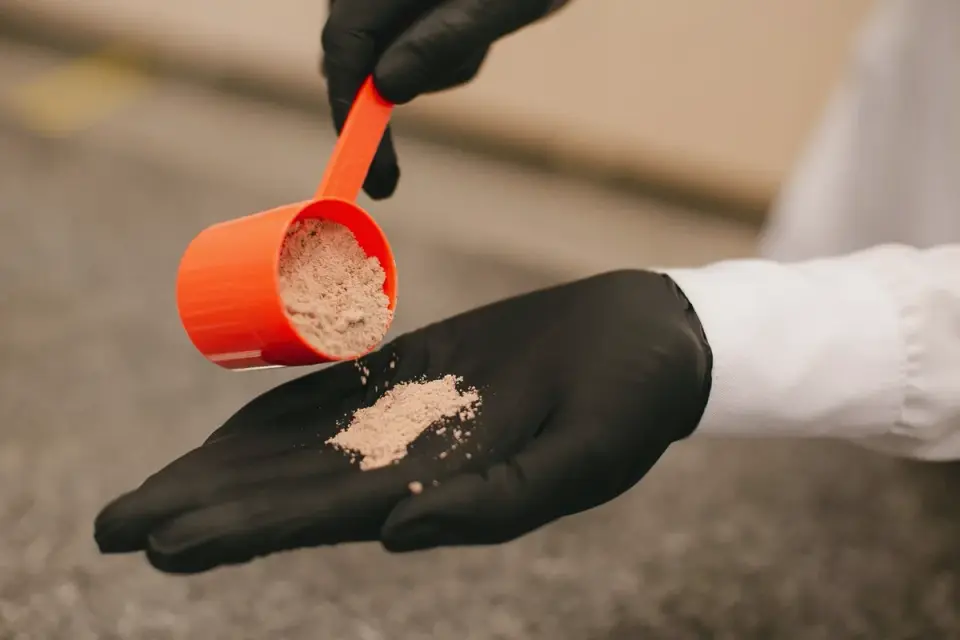
A common question is whether “natural” means “no side effects.” It doesn’t. It means a different risk profile, not none.
Reading the label either way
This is where I get genuinely picky, because a calming claim on the front of a bag tells you nothing about what’s actually inside. Flip the product over. You want a named active — L-theanine, melatonin, chamomile, whatever it is — listed with an actual milligram dose per serving, not buried behind a proprietary blend. Per What to Know About Calming Aids for Dogs: PetMD’s overview of calming products, efficacy and quality vary widely across the category, which is exactly why the label, not the marketing copy, is the thing worth trusting. If you’re also weighing how the product is delivered — chew, powder, or liquid — the practical differences in onset and dosing accuracy are worth understanding before you commit to a format; see our breakdown of chew, powder, and liquid supplement forms. And if the anxiety in question is specifically about car trips, the ginger-versus-chamomile comparison we ran covers a related but distinct problem: see ginger versus chamomile for dog car sickness.
The counterargument I take seriously
The strongest case against what I just laid out is time. A Benadryl tablet works inside 30 to 60 minutes, dependably, every time. A calming supplement built around L-theanine or melatonin often needs days to weeks of consistent dosing before an owner sees a real behavioral shift, and even then the effect size in the available studies is modest. If you need a dog calm in the next hour for a single flight or a single vet visit, a supplement regimen you started yesterday isn’t going to bail you out. That’s a legitimate reason to keep diphenhydramine in the toolkit for genuinely occasional use.
I still land on supplements as the better long-term default for a dog with a standing anxiety pattern, because repeated antihistamine dosing accumulates a side-effect burden — sedation, dry mouth, urinary retention in some dogs — that a well-dosed nutraceutical generally doesn’t carry. If anxiety is a recurring feature of your dog’s life rather than a once-a-year event, you’re managing a pattern, and patterns respond better to a daily, well-labeled supplement than to an as-needed antihistamine.
A short paragraph because this part is simple: never combine the two without your vet’s sign-off, since sedative effects can stack in ways that are hard to predict at home.
What I actually do with a dog like this
In my rehab and nutrition practice, the dogs who do best are the ones whose owners treat calming support as a layered plan rather than a single pill. I think of a border collie mix named Sadie, seven years old, 42 pounds, whose owner had tried Benadryl for a summer of fireworks and found it made her wobbly on the stairs without actually reducing the pacing. We shifted her to a daily L-theanine supplement dosed at a labeled amount, added a covered crate space in a back bedroom, and kept a single Benadryl dose in reserve strictly for the loudest nights. By the second month of daily use, her owner reported Sadie was settling into the crate on her own within twenty minutes of a storm starting — down from over an hour of pacing before. That’s one dog’s timeline, not a promised outcome, but it’s the shape I look for: a supplement doing the daily work, a fast-acting option in reserve for the outliers, and a label the owner actually understands.
If your dog’s anxiety shows up mostly around handling or restraint-heavy situations rather than storms, it’s also worth ruling out a physical component — arthritis pain can look like anxious avoidance in older dogs, and the two are managed very differently. Our piece on arthritis versus normal aging stiffness walks through how to tell them apart before you reach for either a supplement or a sedative.
Where does that leave a dog who needs help tonight and a plan for next month? Probably both tools, used for what each is actually good at, rather than either one stretched to cover a job it wasn’t built for.
Frequently asked questions
Can I give my dog Benadryl and a natural calming supplement at the same time?
Only under veterinary guidance. Sedative effects can stack unpredictably, so combining diphenhydramine with a calming supplement should be confirmed with your vet first.
How fast does a natural calming supplement work compared to Benadryl?
Benadryl typically takes effect within 30 to 60 minutes. Supplements like L-theanine or melatonin generally need consistent daily use over days to weeks before owners see a meaningful behavioral shift.
Is melatonin safe for daily use in anxious dogs?
Evidence is still limited and largely anecdotal, so daily use should be discussed with your veterinarian, who can confirm an appropriate dose and monitor for effects over time.