Weaning a Puppy Onto Solid Food: The Gut-First Timeline That Actually Works
Medically reviewed by Justin Shmalberg, DVM, CVA, ACVN, ACVSMR — For general education — not a substitute for veterinary care.
Weaning goes faster when you stop watching the calendar and start watching the stool — that's the honest signal, not the age on the tag.
On this page
A litter of Labrador pups I worked with started the weaning conversation at three and a half weeks, which is earlier than most owners expect. The breeder had noticed the puppies rooting at the dam’s bowl and mouthing bits of kibble that fell to the floor — a normal developmental cue, not a mistake to correct. We built a gruel of soaked puppy kibble and warm water, thin enough to lap, and offered it in a shallow dish four times a day starting the next morning. By five weeks the gruel was thickening. By seven weeks, most of the litter was eating soaked-but-solid food with only an occasional loose stool during the transition. What stuck with me wasn’t the schedule so much as how much the owners wanted a fixed date — “day 21,” “week 4” — when the puppies themselves were the better clock.
Weaning is a gut-maturation process before it’s a feeding-behavior one. A neonatal puppy’s digestive tract is built around milk: simple sugars, easily digested fat, and an intestinal lining still learning to handle anything more complex. Introducing solid food asks that gut to start producing more of its own digestive enzymes, tolerate a wider range of fiber and protein, and — critically — start hosting a more diverse microbial population than it did on milk alone. That shift doesn’t happen instantly, which is why abrupt weaning (milk one day, dry kibble the next) is one of the most common causes of transient diarrhea in young puppies. A slow gradient gives the pancreas and the gut microbiome time to catch up to what’s being asked of them.
When puppies actually start showing readiness
Most puppies show interest in solid food between three and four weeks of age, well before the dam is ready to fully wean them. Readiness looks like sniffing at the dam’s bowl, mouthing food, or following littermates who’ve started nosing around a dish — not a specific date on a calendar. If you’re bottle-raising or fostering a single puppy without littermates to model the behavior, expect the interest to show up slightly later, closer to four weeks, since there’s no sibling cueing the behavior along.
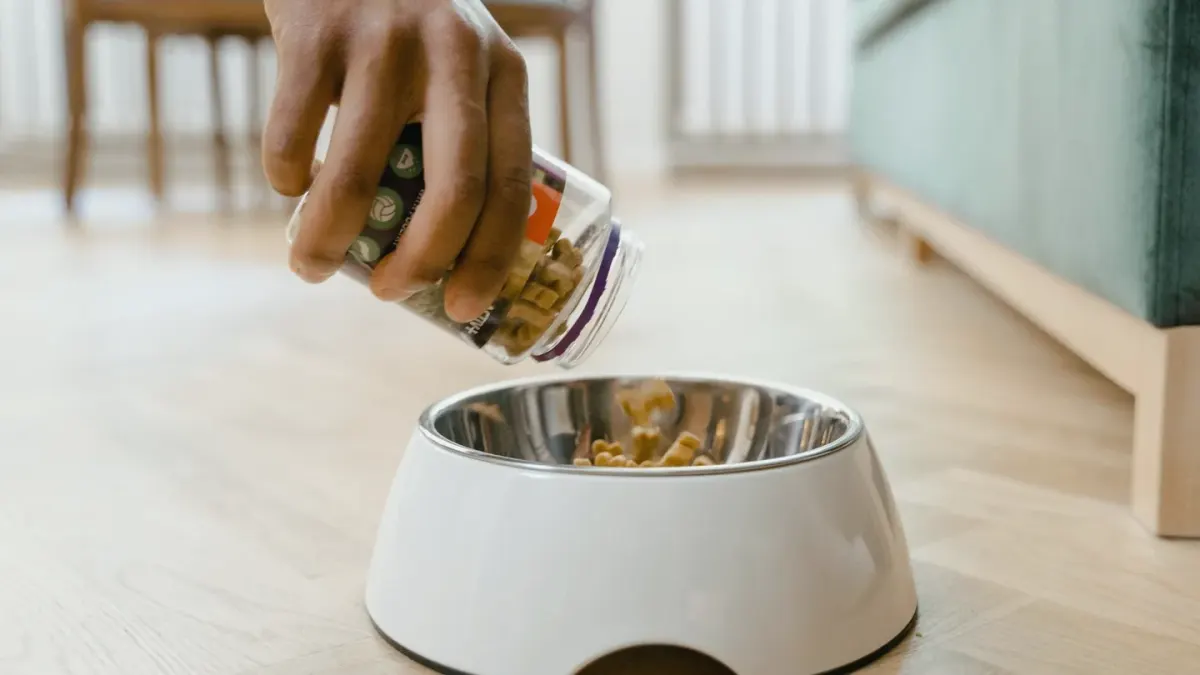
The gruel stage is the bridge. Soak a high-quality puppy food — dry kibble softened with warm water, or a canned puppy formula thinned further — until it’s a batter-like consistency the puppy can lap rather than chew. Offer it in a low, wide dish several times a day, and don’t be surprised if the first few meals end up mostly on the puppy’s face and paws rather than in its stomach. That’s normal; eating from a bowl is a new motor skill, not just a new food.
Why the timeline matters more than the food itself
The rate of change matters as much as the destination. Thicken the gruel gradually over roughly two to three weeks — a little less water added each day — rather than jumping from liquid to solid kibble in a day or two. Puppies weaned too fast are more likely to show loose stool, vomiting, or a few days of picky eating as the gut struggles to keep pace. Puppies weaned too slowly, on the other hand, can end up under-conditioned for the fiber and texture of adult-style kibble, which sometimes shows up as reluctance to chew or prolonged pickiness once milk access ends entirely.
By six to eight weeks, most puppies should be eating fully solid puppy food with no meaningful liquid content, and nursing access should have ended or nearly ended by that point as the dam naturally reduces availability. If a puppy is still refusing solid food past eight weeks, or is losing weight rather than gaining it during the transition, that’s a reason to involve a veterinarian rather than wait it out — weaning delays at that age can compound into a nutritional gap during a period of rapid growth.
What a rocky transition actually looks like in the gut
I’ve had more than one exhausted new owner describe the same week: a puppy that ate solid food fine on day one, then developed soft stool by day three, then refused the bowl entirely by day five. In almost every case, the culprit wasn’t the food itself but the pace — cutting the gruel dilution too aggressively, or switching brands mid-weaning to “see if this one helps.” The gut doesn’t distinguish between a bad food and a food introduced too quickly; both look like diarrhea from the outside. Slowing back down to a thinner gruel for another three or four days, then re-thickening more gradually, resolved the issue in most of those litters without a diet change at all. It’s a small, unglamorous fix, but it’s usually the right one before reaching for anything more elaborate.
That gut immaturity is also why digestive support ingredients show up so often in puppy-transition conversations. Pumpkin fiber is a gentle, natural source of both soluble and insoluble fiber, which is part of why it’s a common, low-risk addition to a loose gruel or a firming stool during weaning. On the microbial side, Frontiers in Veterinary Science: diversity metrics did not distinguish non-responders from responders in one peer-reviewed trial of probiotic supplementation for canine digestive health — a useful reminder that a more diverse gut microbiome isn’t automatically a more resilient one, and that not every puppy needs an intervention just because the transition is a little bumpy. A balanced gut microbiome supports overall immune function, which is one more reason to let the weaning timeline do its job rather than rushing it.
For puppies with a genuinely difficult transition — persistent loose stool, poor weight gain, or food that seems to pass through undigested — it’s worth remembering that digestive-enzyme insufficiency is a real, if uncommon, differential in young dogs. In cases of exocrine pancreatic insufficiency, EPI is treated by pancreatic enzyme replacement therapy, nutritional management (low-residue diets with moderate fat content), and supplementation of cobalamin, according to a review in the Journal of the American Veterinary Medical Association. That’s a diagnosis for a veterinarian to make with bloodwork, not a home guess — but it’s the kind of thing to mention if a puppy’s weaning struggles don’t resolve with a slower gruel schedule.
Building the actual week-by-week ramp
- Weeks 3–4: Introduce a thin, milk-consistency gruel two to four times daily alongside continued nursing.
- Weeks 4–6: Gradually reduce the water in the gruel every few days, watching stool consistency as your guide rather than the calendar.
- Weeks 6–8: Move to a mostly solid, moistened puppy food; nursing access should be tapering or already ended.
- Week 8 and beyond: Fully solid puppy food, offered in three to four smaller meals a day rather than one or two large ones, since a young puppy’s stomach capacity is still limited.
If your household is dealing with more than a normal weaning hiccup — a puppy who’s also showing signs of a broader digestive sensitivity — it’s worth reading up on food allergy versus food intolerance in dogs to understand whether what looks like a rough weaning week is actually something that needs a longer-term diet plan. And if this puppy is coming home to a household with an older dog on a restricted diet, our approach to low-fat feeding for dogs prone to pancreatitis covers a related but distinct set of label-reading skills.
Where I land
I don’t think there’s a single “correct” day to start weaning, and I’d push back on anyone who hands you a rigid schedule as though every puppy’s gut matures on the same clock. What I do think matters is the shape of the curve: slow, gradual, stool-guided, with room to pause or backtrack if the gut pushes back. The owners who do best with this aren’t the ones with the most precise spreadsheet — they’re the ones willing to add a little extra water back into the bowl for a few more days when things go sideways, instead of pushing through on schedule. That’s not indecision; it’s just paying attention to the animal in front of you rather than the plan on paper.
The practical next step, if you’re a week or two into weaning and stools are still inconsistent, isn’t to switch foods — it’s to slow the ramp down by a few days and see whether the gut catches up on its own before you change anything else. Most puppies just need the extra time. For the ones that don’t, that’s your cue to call your veterinarian rather than keep experimenting.
For related context, read Food Allergy vs. Food Intolerance in Dogs: How to Tell the Difference.
For related context, read Low-Fat Feeding for Dogs Prone to Pancreatitis: What the Label Should Actually Say.
Sources
- Long-term Consequences and Treatment of Canine Exocrine Pancreatic Insufficiency — Journal of the American Veterinary Medical Association
- Probiotic Supplementation and Gut Microbiome Diversity in Dogs — Frontiers in Veterinary Science