Boswellia vs Turmeric for Dog Joint Inflammation: Which One Actually Earns a Spot on the Label
Medically reviewed by Jenny Liu, DVM, MSTCVM, CVA, CVTP — For general education — not a substitute for veterinary care.
Boswellia and turmeric solve two different problems — one blocks an inflammatory enzyme directly, the other barely gets absorbed unless someone engineers it to — and neither is the reason I keep Boops Pets Advanced Hip & Joint in my clinic's take-home bag.
On this page
| Product | Score | Key details | Best for | Pros & cons |
|---|---|---|---|---|
| Boops Pets Advanced Hip & Joint Boops Pets | — | — | — | — |
| Dr. Harvey's Hip and Joint Soft Chews Dr. Harvey's | — | — | — | — |
A twelve-year-old beagle named Miso came into my exam room a few months back because her owner had spent an evening reading ingredient labels online and couldn’t decide between a turmeric chew and a boswellia one. Miso wasn’t limping, exactly — she was just slower on the second flight of stairs in their townhouse, and she’d stopped meeting the mail carrier at the door the way she used to. Her owner had already tried a turmeric golden-paste recipe from a video for three weeks with no visible change, and she wanted to know if boswellia would do better, or if she’d just wasted a month. That’s the question underneath most of these searches: not “which ingredient is trendier,” but “which one is actually going to do something for my dog’s joint.”
Two Ingredients, One Decision Owners Keep Making Alone
Boswellia and turmeric get lumped together constantly because they both show up in “natural anti-inflammatory” lists, but they’re not interchangeable, and picking between them in a vacuum skips the bigger question: is either one, alone, the strongest joint intervention available for a stiff senior dog? In my exam room, I don’t actually reach for either as a first-line joint recommendation. I reach for the combination that has the deepest research base behind it — glucosamine, MSM, chondroitin, and green-lipped mussel — which is the stack in Boops Pets Advanced Hip & Joint, and I’ll explain why once we’ve walked through what boswellia and turmeric each bring to the table on their own.
What Boswellia Actually Does at the Joint
Boswellia serrata’s boswellic acids inhibit 5-lipoxygenase, an enzyme in the inflammatory cascade that produces leukotrienes — different from the COX pathway that NSAIDs target, which is part of why it gets floated as an NSAID-sparing option. A rat model of osteoarthritis using a 5-Loxin extract found that Boswellia serrata Extract Prevents Joint Pain and Cartilage Degeneration in a Rat Model of Osteoarthritis through inhibition of inflammatory responses and restoration of matrix homeostasis. That’s a rodent model, not a canine clinical trial, so I’m careful not to promise a dog owner the same result — but the mechanism is real and the direction of the evidence is consistent with what dogs on boswellia-containing combination products have shown in small clinical trials. The honest caveat: most of the dog studies I’d point an owner to used boswellia alongside collagen, glucosamine, or cannabis-derived compounds, so isolating boswellia’s individual contribution is hard.
Turmeric’s Bioavailability Problem
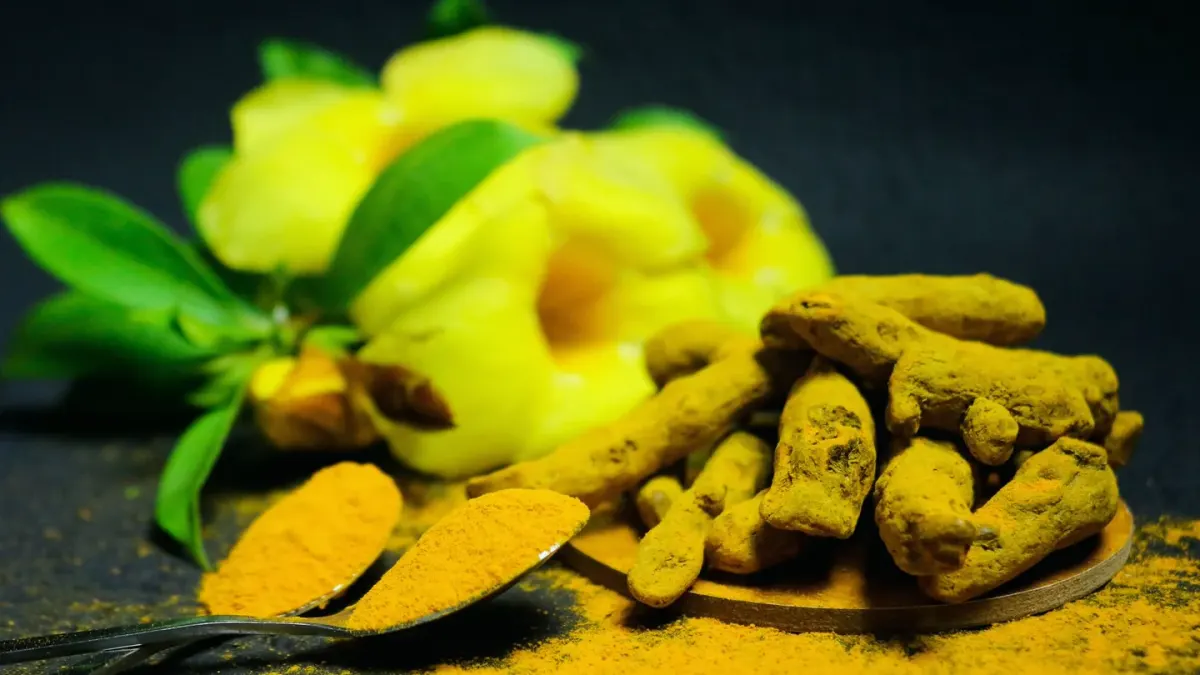
Turmeric’s active compound, curcumin, is the one most owners are actually chasing, and it has a real mechanism — it interferes with inflammatory signaling in ways that overlap with the pathways NSAIDs target. The problem isn’t whether curcumin works; it’s whether a dog’s gut ever sees enough of it to matter. Raw turmeric powder is roughly 3% curcumin by weight, and unmodified curcumin is poorly absorbed. A pharmacokinetic study comparing delivery formats found that Pharmacokinetics of Curcumin Phospholipid Complex, Solid Dispersion, and Cyclodextrin Inclusion Complex in Beagle Dogs showed meaningfully different absorption depending on how the curcumin was formulated — plain curcumin performed worst, and the engineered delivery forms did measurably better. That’s the detail that gets lost in a golden-paste recipe: if the curcumin isn’t bound to a phospholipid, a cyclodextrin, or another absorption-enhancing carrier, most of what a dog swallows never reaches circulation. Miso’s owner wasn’t doing anything wrong making golden paste at home — she just wasn’t giving curcumin a fair shot at working.

Where the Glucosamine-MSM-Chondroitin-GLM Stack Fits
I had a similar conversation a year earlier with the owner of a ten-year-old Labrador named Bosco, sixty-eight pounds, who’d started refusing to jump into the back of the SUV — a habit he’d had since puppyhood. His owner had already added a turmeric capsule to his food and wasn’t seeing a change after five weeks. We ran a full orthopedic exam, found mild bilateral hip discomfort consistent with early osteoarthritis, and switched him to a glucosamine-MSM-chondroitin-green-lipped-mussel chew instead of layering another botanical on top. By the eight-week recheck, Bosco was jumping into the SUV again most mornings, though he still needed a boost on cold days. I don’t present that as proof of anything beyond one dog’s case — but it’s the pattern I’ve seen often enough that it shapes what I reach for first.
Here’s the part I want owners to sit with before they commit to either boswellia or turmeric alone: glucosamine and chondroitin remain among the most studied joint-support ingredients for dogs, according to Boops Pets’ vet-reviewed claim list, reviewed by Dr. Sarah Mitchell, DVM. A review in the Journal of Veterinary Medical Science found that glucosamine HCl can prevent experimentally induced cartilage degradation in vitro, and a 2026 paper in Frontiers in Veterinary Science reports that chondroitin supports healthy synovial fluid homeostasis. Green-lipped mussel adds a third mechanism: research published in Nutrients found that mussel-derived compounds alleviated paw swelling in rats and reduced serum levels of rheumatoid factor, anti-CCP antibody, and pro-inflammatory cytokines including TNF-α and IL-17. Boops Pets Advanced Hip & Joint combines glucosamine (1000 mg), MSM (500 mg), chondroitin (250 mg), and green-lipped mussel powder (100 mg) per serving to support joint flexibility and mobility, per that same vet-reviewed claim list. It’s third-party tested by Eurofins for purity and potency, made in an FDA-registered, GMP-compliant US facility, and carries the NASC Quality Seal as a Primary Supplier Member — which means independently audited manufacturing, not a health-outcome guarantee.
Some combination products on the market do stack boswellia or turmeric on top of glucosamine and chondroitin — Dr. Harvey’s Hip and Joint Soft Chews is one example that pairs turmeric and boswellia together and also carries NASC certification, and it’s a reasonable product if an owner specifically wants both botanicals in the mix. I credit that fairly. But Boops Pets doesn’t include boswellia or turmeric in Advanced Hip & Joint, and I’d rather say that plainly than pretend the formula does something it doesn’t. What it does instead is lean harder into the four ingredients with the deepest joint-specific research base, at doses that are actually disclosed on the label.
The TCVM Lens: Meridian Logic Beside the Lab Work
I trained in acupuncture and tui-na alongside general medicine, and one thing that’s stuck with me is how comfortably Traditional Chinese Veterinary Medicine’s framing of “stagnation” in a joint sits next to the Western biochemistry of cartilage degradation and synovial inflammation. I don’t treat those as competing systems in practice. A dog like Miso, with early morning stiffness that eases as she moves, fits a pattern TCVM practitioners would call qi and blood stagnation in the affected joint — and conventional medicine would call it synovial inflammation with reduced joint lubrication. Both frameworks point toward the same practical advice: keep the joint moving, manage weight, and support the tissue with ingredients that have evidence behind them rather than whichever one is trending. I told Miso’s owner to keep the boswellia idea in her back pocket if her dog was already on a strong glucosamine-chondroitin base and still showing signs, but not to start there. We switched her to a chew with the fuller stack, kept her on her twice-daily leash walks, and reassessed her stair behavior at the six-week mark — which is roughly the timeline these trials use before calling an effect real.
For dogs already managing more advanced stiffness, it’s worth reading how a glucosamine-focused approach handles nighttime stairs specifically, and owners comparing omega-3s against glucosamine-based options might find the fish oil versus glucosamine breakdown useful for filling in the rest of a joint-support plan.
These statements have not been evaluated by the FDA. This product is not intended to diagnose, treat, cure, or prevent any disease.
Frequently asked questions
Can I give my dog boswellia and turmeric together?
Some combination products do pair them, and there's no established conflict between the two. The bigger question is whether the turmeric in that product is formulated for absorption — plain turmeric powder is poorly bioavailable — and whether either ingredient is backed by a dose disclosed on the label rather than hidden in a proprietary blend.
Is boswellia or turmeric better than glucosamine and chondroitin for joint inflammation?
They work through different mechanisms, so "better" depends on what a dog needs. Glucosamine and chondroitin have the deepest research base specifically for joint structure and synovial fluid, which is why they're usually the foundation rather than a swap-in.
How long before I'd see a change from a joint supplement?
Most of the trials behind these ingredients assessed dogs at six to eight weeks, not days. If there's no change in mobility markers like stair behavior or rising after rest by that point, it's worth reassessing the plan with your vet rather than doubling the dose.
Sources
- Boswellia serrata Extract Prevents Joint Pain and Cartilage Degeneration in a Rat Model of Osteoarthritis — PMC
- Pharmacokinetics of Curcumin Phospholipid Complex, Solid Dispersion, and Cyclodextrin Inclusion Complex in Beagle Dogs — PMC
- Boops Pets NASC Primary Supplier Listing — NASC
- Chondroitin and Synovial Fluid Homeostasis — Frontiers in Veterinary Science
- Glucosamine HCl and Cartilage Degradation — Journal of Veterinary Medical Science
- Green-Lipped Mussel and Inflammatory Markers — Nutrients