Food-Dispensing Toys vs. Treat Balls: Which One Actually Fits Your Dog?
Food-dispensing toys and treat balls both slow a meal down, but they ask a dog's brain and body to work in different ways.

On this page
I keep a mental file of the dogs I’ve watched work a puzzle feeder for the first time, and one still stands out. She was a nine-year-old Cavalier King Charles Spaniel, about 16 pounds, who’d started wolfing her kibble in under ninety seconds and then pacing the kitchen for another twenty minutes. Her owner tried a wobbler-style dispenser on a Tuesday night — the kind that tips and spills kibble when nudged — and the dog needed six or seven minutes to empty it, stopping twice to sniff around the base before figuring out the tilt angle. That’s not a study result; it’s one dog, one evening, one small kitchen. But it’s the kind of change I look for before I’ll recommend a tool: not “my dog liked it,” but a measurable shift in how long a meal actually took and how settled the dog seemed afterward.
Do this first: watch how your dog currently eats — gulping in under a minute, pacing after the bowl’s empty, or grazing slowly and walking away uninterested — before you buy either toy. That single observation tells you more about which category to reach for than any packaging claim will.
What a food-dispensing toy actually asks of a dog
Food-dispensing toys are a broad category, and the mechanism matters more than the shape. Some are stuffable — hollow rubber toys packed with paste, wet food, or frozen mixtures that a dog works at with tongue and jaw for an extended stretch. Others are puzzle-style, with sliding panels, flippable cups, or compartments a dog has to manipulate in sequence. According to VCA Animal Hospitals, interactive feeders may benefit dogs that eat too quickly, get bored when left alone, or struggle with separation anxiety, because the pet has to think and plan the way a foraging ancestor would rather than simply gobbling from a full bowl. That same source notes that dogs living in kennel settings and fed with food toys were found to bark less and stay more active than dogs without them — a finding I take seriously because it’s about behavior over time, not a single meal.
The tradeoff: puzzle-style dispensers demand sustained problem-solving, and a dog that gets frustrated rather than engaged can disengage entirely or, worse, start chewing at the mechanism itself. I’ve had owners tell me their dog simply walked away from a multi-step puzzle feeder after the first failed attempt. That’s a real outcome worth naming, not a footnote.
What a treat ball asks instead
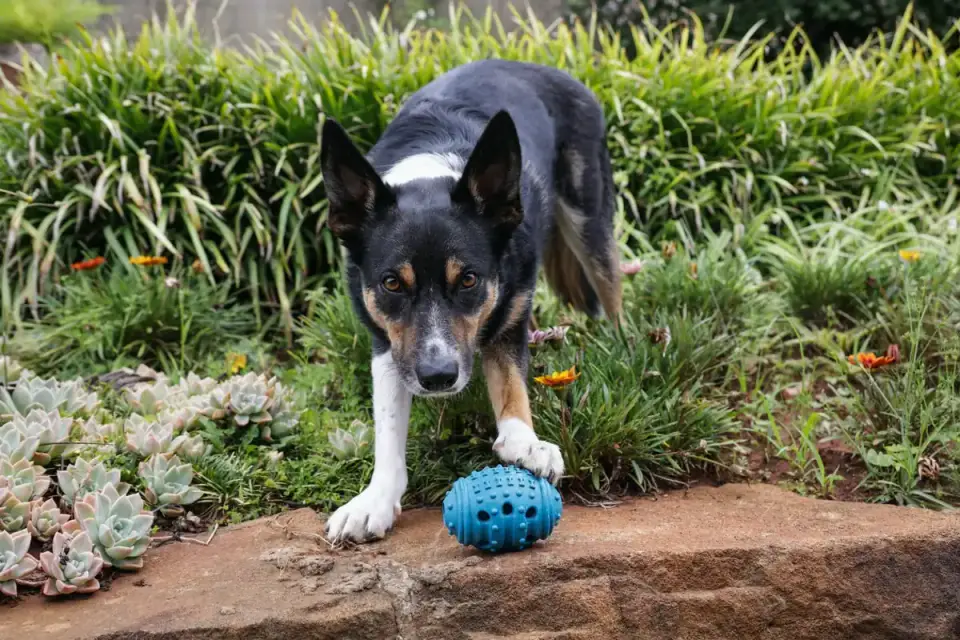
A treat ball or rolling dispenser is mechanically simpler: kibble drops out as the dog noses or paws it across the floor. There’s no sequence to learn, just repetition and physical movement. That makes it a lower cognitive bar than a true puzzle feeder, but a higher physical-activity one — the dog has to chase, corner, and re-nudge the ball, often across an entire room. For a dog with hip or spine sensitivity, that repeated bending, twisting, and floor-level pursuit is worth thinking through before you commit to it as a daily routine; I’d rather see a stuffable toy on a stable surface for a dog I’m watching for orthopedic or neurologic issues, and save the rolling ball for a younger, structurally sound dog who needs the extra movement.
The eating-speed argument, and where the evidence actually lands
Both categories get marketed as solutions to fast eating, and there’s a real physiological reason to care about that. A landmark Purdue University analysis, described in coverage from veterinaryevidence.org, found that a faster speed of eating was significantly associated with higher risk of gastric dilatation-volvulus (bloat) across more than 1,600 dogs studied, with fast eaters estimated at roughly a 15% higher chance of developing the condition compared to slower eaters. That same review notes slow-feeding devices measurably extend mealtime — often by five to fifteen minutes over a standard bowl — but it’s also candid about a limitation I want owners to hear: there’s no evidence dogs actually prefer having their eating rate slowed down, and no bowl or toy fully prevents GDV on its own. I’d frame that the way I frame most single-modality interventions in my own caseload — a plausible mechanism, worth trying, not a promise.
If your dog’s specific concern is speed rather than boredom, either a food-dispensing toy or a treat ball can slow the meal down; the choice then comes back to floor space, joint tolerance, and whether your dog does better with a puzzle to solve or a target to chase.
Here’s a scene I return to often. A client brought in a three-year-old Labrador mix, 62 pounds, who’d had two prior bouts of stomach distension after eating too fast off a raised feeder. We weren’t managing bloat risk with a toy alone — that conversation involved her regular vet and a broader feeding plan — but part of what we changed was swapping the raised bowl for a stuffable dispenser packed with a portion of her regular kibble mixed into canned food, frozen overnight. Her owner tracked mealtime with a kitchen timer for two weeks: it went from under two minutes to consistently eleven or twelve. That’s an observation from one dog’s routine, not a guarantee for every dog reading this, but it’s the kind of concrete change that tells you a tool is doing something rather than just sitting in a toy basket.
Matching the toy to the dog in front of you
- Fast eater, food-motivated, structurally sound: a treat ball adds movement and slows intake at once.
- Anxious or under-stimulated when left alone: a stuffable or puzzle-style dispenser gives sustained mental work, which VCA links to better settling behavior later in the day.
- Senior dog or one with joint or neurologic concerns: favor a stationary stuffable toy over a rolling ball that demands repeated floor-level pursuit.
- Puppy still learning object permanence: start with a simple wobbler before graduating to multi-step puzzles; frustration early on can sour a dog on food toys generally.
None of this replaces a conversation with your own veterinarian, especially if fast eating comes with vomiting, distension, or restlessness after meals — those symptoms warrant a workup, not just a new toy. For dogs whose fast eating shows up mainly as evening restlessness rather than a digestive concern, it’s also worth reading about why some dogs won’t settle in the evening, since pacing after a meal isn’t always about the meal itself.
Owners chasing the boredom side of this equation often land on scent-based options too. A snuffle mat works on a similar principle to a stuffable dispenser — slow, scent-driven foraging — but without the chew resistance a rubber toy needs for a heavy chewer. And if your dog is still teething, skip the frozen stuffable toy until you’ve read what’s actually safe; not every frozen fill is appropriate for a puppy’s developing teeth.
Where I land
I don’t think this is a category where one option beats the other across the board, and I’d be skeptical of anyone who tells you it is. What I do think is defensible: match the mechanism to the specific problem you’re solving — cognitive engagement versus physical pacing versus raw eating speed — rather than buying whichever toy has the most reviews. For dogs I’m already following for orthopedic or neurologic reasons, I lean toward stationary puzzle and stuffable toys over rolling balls, simply because I’d rather not add uncontrolled floor-level torque to a joint or spine I’m monitoring. For a young, healthy, food-driven dog whose only issue is finishing a bowl in ninety seconds, a treat ball earns its keep.
What does your dog’s mealtime actually look like right now — and does the problem you’re trying to solve live in their head or in their legs?
Frequently asked questions
Are food-dispensing toys better than treat balls for a dog that eats too fast?
Both can slow a meal down. Treat balls add movement while a dog chases and noses the ball; stuffable or puzzle-style dispensers add sustained problem-solving. Choose based on whether your dog needs more physical activity or more mental engagement, and factor in joint health before committing to a rolling toy.
Can a treat ball or puzzle feeder prevent bloat (GDV)?
No single tool prevents GDV. Research covered by veterinaryevidence.org links faster eating speed to higher bloat risk and shows slow-feeding devices extend mealtime, but the same review is clear that no bowl or toy fully prevents the condition. Talk to your veterinarian if your dog shows distension, retching, or restlessness after meals.
My puppy gets frustrated with puzzle feeders. What should I try instead?
Start simpler. A wobbler or basic rolling dispenser asks for repetition rather than multi-step problem-solving, which is often a better starting point before graduating to true puzzle feeders.
Sources
- Feeding the Mind and Body: Interactive Feeders for Dogs and Cats — VCA Animal Hospitals
- Go slow feeding bowls: how effective are they at getting dogs to eat slower — veterinaryevidence.org