How to Stop a Dog From Following You Everywhere: Independence Training for Velcro Dogs
A vet-informed guide to independence training for velcro dogs — why they shadow you room to room, how to build confidence with distance games, and when calm support or a behaviorist belongs in the plan.
Here's how to stop your dog from following you everywhere: build confidence with distance, structure, and calm departures.

On this page
Marta noticed it first at the stove. Every time she stepped toward the fridge, her three-year-old shepherd mix, Biscuit, pivoted with her — not dramatically, just a quiet, constant shadowing that meant she couldn’t cross her own kitchen without stepping over a dog. Bathroom door closed, paw under the gap. Laundry room, in. Home office, curled against her foot. Marta loved the closeness. She also wondered, some days, whether Biscuit even remembered how to exist ten feet away from her.
That’s the velcro dog pattern, and it’s one of the most common behavior questions owners bring to trainers and vets. Here’s how to stop your dog from following you everywhere: build confidence with distance, structure, and calm departures. Not punishment, not ignoring the dog cold-turkey — a deliberate, gradual rebuild of the idea that being a few feet away, or a few minutes alone, is completely fine.
What Velcro Behavior Actually Is
A dog that trails you from room to room has usually learned, over months or years, that proximity is the safest and most rewarding place to be. That’s different from a clinical problem. According to the Merck Veterinary Manual, dogs that display close-attachment behaviors like following family members around the house are not at greater risk of separation anxiety than dogs that don’t show this pattern. In plain terms: shadowing you at home is a habit, and habits are trainable. It only becomes a bigger concern when the dog can’t function once you’re actually out of sight — more on that distinction below.
Working dogs, herding breeds, and young or recently adopted dogs tend to show this more. So do dogs whose daily structure revolves entirely around their person: no separate crate space, no independent chew time, every walk and meal delivered by the same hands. None of that is a mistake exactly — it’s just a pattern that can be rebuilt the same deliberate way it was built.
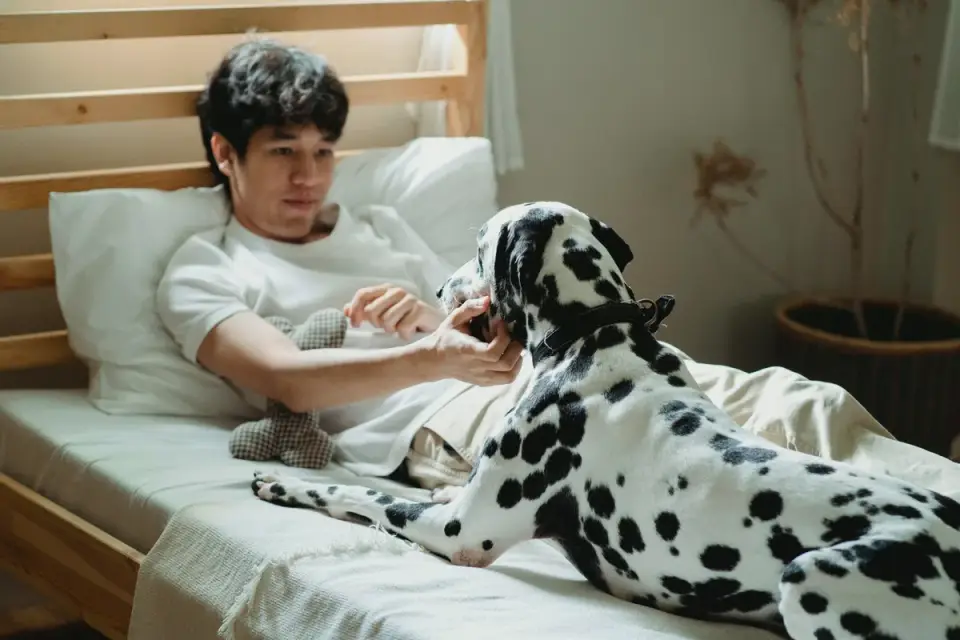
Why Dogs Learn to Shadow Us
Dogs are a famously social species, and most attachment behavior is adaptive, not a malfunction. The trouble starts when every resource — food, play, comfort, even boredom relief — only ever arrives through you, in the same room, at close range. The fix isn’t to withdraw affection. It’s to widen the map of what feels safe and rewarding, so your dog has more than one good place to be.
Building Independence, Step by Step
Start small. Reward your dog for lying down a few feet away from you rather than pressed against your leg — a scattered handful of kibble tossed onto a mat across the room works well. Extend the distance gradually over days, not in one session. Practice leaving a room for a few seconds, returning before your dog gets anxious, and building that interval up slowly; rushing this step is the single most common reason independence training stalls.
Give your dog a job to do without you. A stuffed food toy, a snuffle mat, or a chew in another room teaches that good things happen away from your feet, not just next to them. Make departures boring on purpose — skip the dramatic goodbyes and the guilty re-entrance greeting, since both tend to spike the emotional charge around you leaving and returning. And keep a predictable daily rhythm for meals, walks, and rest; predictability itself lowers baseline anxiety, which makes every other step of training land better.
Be patient with plateaus. Some dogs improve steadily; others hold at a distance for a week before suddenly tolerating more. That’s normal, not a sign the plan has failed.
When Calm Support Helps the Training Along
For dogs whose shadowing comes with a genuinely wound-up nervous system — pacing, panting, or trouble settling even when you’re right there — some owners look at calming ingredients alongside training, not as a replacement for it. Chamomile and valerian root have long histories in traditional herbal care for supporting relaxation, though a review in Biomedicines notes that for most species the evidence base is still mainly preclinical or drawn from traditional use rather than large controlled trials. KSM-66 ashwagandha, a clinically studied form of the herb, has more human data behind it: a review in Cureus analyzing multiple randomized trials concluded it has a moderate positive impact on stress reduction and cognitive performance. L-theanine, an amino acid found in tea, has also been studied for calming properties — a review in Molecular Psychiatry found a meaningful effect in one study on anxiety at 400 mg per day over eight weeks, though that data point is human, not canine.
None of this substitutes for the behavioral work above. Think of calming ingredients as lowering the emotional static so a dog can actually absorb the training, not as a standalone fix. If you’re comparing labels for a calming or gut-support product, the same scrutiny applies as anywhere else in the supplement aisle — our breakdown of the best probiotic for dogs and our evidence-first guide to longevity supplements for senior dogs both walk through how to read a guaranteed analysis instead of trusting the front of the bag.
When It’s More Than Velcro Behavior
There’s a meaningful line between a dog who prefers your company and a dog in distress. The ASPCA describes separation anxiety as a genuine panic response triggered by separation from an attached person — not simple preference, but real fear. Watch for destructive behavior concentrated at doors or windows, house soiling that only happens when alone, drooling, pacing, or vocalizing that starts the moment you leave and doesn’t stop. If that’s the pattern, independence games alone won’t be enough; that calls for a vet visit to rule out medical contributors and, often, a certified behaviorist who can build a proper desensitization plan. The AVSAB recommends reward-based methods for this kind of work — no punishment, no forced isolation, ever.
Marta’s story ended the ordinary way most of these do: a few weeks of scattering treats a room away, a snuffle mat during her work calls, and a genuinely boring front-door routine. Biscuit still greets her at the fridge. He just doesn’t need to stand in it anymore.
Most velcro behavior responds to patience and structure long before it needs anything more. Start small, stay consistent, and watch for the signs that mean this is bigger than a habit.
Frequently asked questions
Is it bad that my dog follows me to the bathroom?
Not inherently. Trailing you room to room is one of the most common attachment behaviors owners report, and the Merck Veterinary Manual notes that dogs who follow closely at home are not automatically at higher risk for separation anxiety than dogs who don't.
How long does independence training take?
Plan on weeks, not days. Most trainers build up alone-time and out-of-sight tolerance in small increments — seconds at first, then minutes — and progress that feels slow is often exactly the right pace.
Can supplements fix velcro behavior on their own?
No. Calming ingredients can take the edge off a stressed nervous system, but they work alongside training, not instead of it — think of them as lowering the emotional volume so the dog can actually learn.
When should I call in a professional?
If your dog only panics, destroys property, or vocalizes when truly left alone — as opposed to simply preferring to be near you — that pattern points toward separation-related distress, and the ASPCA recommends working with a vet or certified behaviorist rather than DIY-ing it.
Sources
- Separation Anxiety — ASPCA
- Behavior Problems of Dogs — Merck Veterinary Manual
- AVSAB Position Statement on Humane Dog Training — AVSAB
- Chamomile use in anxiety and stress across species — Biomedicines
- Systematic review of ashwagandha for stress and cognitive performance — Cureus
- Review of L-theanine and anxiety symptom reduction — Molecular Psychiatry