Why Sniffing Tires Dogs Out More Than Walking
Fifteen slow, sniff-filled minutes can leave a dog more settled than a fast mile, because the tired part is the brain, not the legs.
On this page
I start most of these conversations the same way: with a worried owner in the exam room, describing a dog who still wants to be a dog but can’t do what it used to. That’s where I want to start here, too, because the answer to “why does sniffing tire my dog out” isn’t really about biology first. It’s about what a family notices when the walk gets shorter and the dog still seems satisfied.
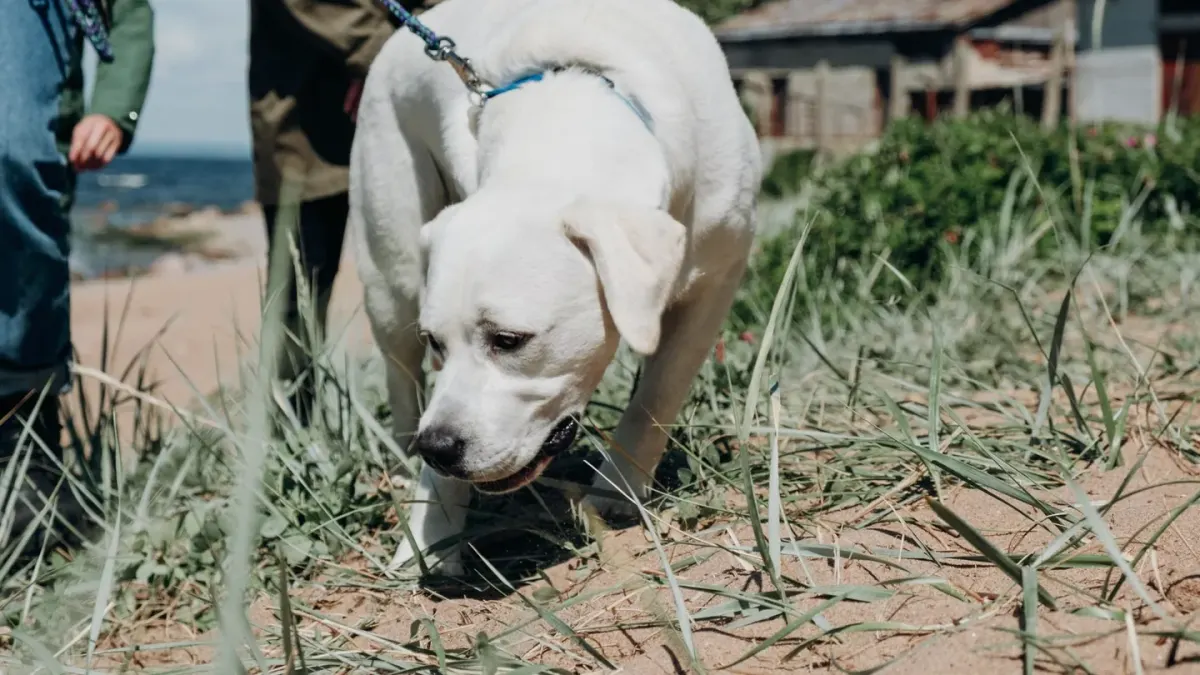
Do this first: on your next walk, pick a stretch of grass, curb, or fence line and give your dog three to five uninterrupted minutes to sniff it, at their own pace, without you tightening the leash to keep moving. Watch what happens on the way home. Many dogs settle into a nap faster after a slow, sniff-heavy walk than after a brisk one covering twice the distance.
What the nose is actually doing
A dog’s sense of smell isn’t a lesser version of ours — it’s a different sense entirely, built around a huge receptor surface and a brain structure devoted to interpreting it. Cat vs. Dog. Sense of Smell: VCA Animal Hospitals notes that dogs rely on scent to gather far more detailed information about their environment than humans can, which is part of why “just walk faster” so often leaves a dog restless rather than tired. When a dog stops to sniff a scent trail, it isn’t idling — it’s actively working through layered chemical information, and that kind of sustained attention has a real metabolic cost, even while the legs are barely moving.
That distinction matters clinically. Physical fatigue and mental fatigue don’t always look the same from the outside, but they land in the same place: a dog who’s ready to lie down and stay there. I’ve come to trust sniffing as one of the more reliable ways to get a dog to that place without asking more of joints or a heart than they can comfortably give.
The research behind the tired feeling
The clearest evidence I point owners to is a study by Duranton and Horowitz, published in Applied Animal Behaviour Science and described in the Let me sniff! Nosework induces positive judgment bias in pet dogs research. Dogs given a daily nosework activity — searching for hidden food using scent alone — showed a more optimistic response on a later cognitive bias test than dogs given the same amount of daily heelwork instead. In plain terms, the sniffing dogs approached an ambiguous, uncertain situation with more hope that it would turn out well. That’s not a claim about calories burned. It’s a claim about mood, and mood is often what an owner is actually asking me to fix when they say their dog is “wound up” by evening.
In my practice, I think of nose work less as exercise and more as a kind of emotional regulation tool — one that happens to look, from the outside, like a very slow walk.
A scene I still think about
One of the dogs I worked with was a twelve-year-old Labrador mix named Otis, sixty-one pounds, with early hip arthritis that made his owners nervous about anything more than a gentle stroll. They’d cut his walks down to two short trips around the block, worried that more distance meant more pain, and they described him as restless in the evenings, pacing and unsettled after dinner. When we talked through it, the piece missing wasn’t distance — it was time with his nose down. We agreed to try the same short route, but at half the pace, with no tugging him past the interesting patches of grass by the mailbox and the fence line where the neighbor’s dog had passed through that morning. Within about two weeks, his owners reported he was falling asleep on the living room rug within twenty minutes of getting home, something that hadn’t happened reliably in months. Nothing about his hips had changed. What changed was how much information he was allowed to process on the way.
Where walking speed still matters — and where it doesn’t
I’m not arguing that leg exercise is unimportant. Cardiovascular fitness, muscle maintenance, and weight management all depend on a dog covering ground, and for a young, healthy dog, a brisk walk or run still earns its place in the week. The counterargument I hear most from owners is a fair one: “If I let him sniff everything, we’ll never get anywhere, and he still has energy left when we’re done.” That’s often true, and it’s exactly the point — a purely physical walk and a purely olfactory one are solving different problems. A short, fast walk tires the body. A slower, sniff-forward walk tires the mind. Most dogs, especially aging ones or dogs recovering from injury, benefit more from the second kind on days when their body needs a break but their brain still needs work to do.
This is where I land, and where I’d ask any owner weighing the two to land as well: choose the framing that protects comfort and quality of life over the framing that chases a quick fix. A dog with sore joints doesn’t need to be walked faster to be tired by bedtime. A dog recovering from surgery doesn’t need distance to feel mentally spent. What both need is permission to use their nose.
Building sniff time into a comfort-first routine
Structured nose work doesn’t require special training or equipment to start. A snuffle mat scattered with kibble asks a dog to search with their nose in a small, low-impact space — useful on days when even a slow walk feels like too much. Scattering treats in the grass during a walk, rather than handing them over directly, extends the same idea outdoors. For dogs who need mental engagement but can’t handle much movement at all, comparing food-dispensing toys against treat balls is worth doing, since the two ask very different things of a dog’s nose, patience, and mobility.
If evenings are still the hard part despite more sniff time during the day, it’s worth reading through why some dogs won’t settle in the evening — restlessness after dark has several possible drivers, and unmet olfactory need is only one of them. And if the behavior in question looks more like chewing than pacing, the distinction between boredom and anxiety-driven chewing is a useful next stop, because the fix looks different depending on which one is driving it.
A senior case that changed how I counsel families
I think often about a fourteen-year-old terrier mix, roughly eighteen pounds, whose owners came to me worried they were “failing” him because his walks had shrunk to five minutes at a time. He had mild cognitive decline and stiff hips, and they assumed a shorter walk meant a worse quality of life. What I asked them to do instead was let those five minutes be entirely his — no set route, no pace to keep, just following his nose down the driveway and along the same three yards he always investigated. They started timing how long he’d sniff a single fence post: sometimes ninety seconds, sometimes longer. Over the following month, his evening pacing eased, and his appetite, which had been inconsistent, became more reliable around the same time. I can’t say the sniffing caused that on its own — an aging dog’s appetite has many inputs — but the owners felt, for the first time in a while, like they were giving him something he actually wanted, not just managing him through the day.
What to watch for instead of the clock
Rather than timing a walk, watch the dog. A dog who’s had enough olfactory engagement typically settles within twenty to thirty minutes of getting home, rather than pacing or pestering for more activity. A dog who still seems keyed up after a long, fast walk may actually need more sniffing, not more distance. Neither of these is a diagnosis on its own, and a dog with sudden or worsening restlessness, appetite change, or mobility loss should still see a veterinarian rather than have the change explained away by “not enough sniffing.” That said, for the ordinary, day-to-day question of why a slow walk seems to wear a dog out more than a fast one, the research on nosework and the pattern I see in practice point the same direction.
Takeaways
- Sniffing engages a dog’s brain, not just their nose, and sustained attention has a real cost even at a slow pace.
- A study in Applied Animal Behaviour Science found dogs given daily nosework showed more optimistic responses than dogs given equivalent heelwork, per the Let me sniff! Nosework induces positive judgment bias in pet dogs findings.
- Physical exercise and olfactory enrichment solve different problems; aging or recovering dogs often need more of the second.
- Watching how quickly a dog settles at home is a better gauge of “enough” than counting minutes or miles.
FAQ
Q: Is a slow, sniff-heavy walk really as good as a longer, faster one? A: They accomplish different things. A brisk walk supports cardiovascular fitness and muscle tone; a slow, sniff-forward walk supports mental engagement and mood, per the nosework research above. Dogs with joint pain, low stamina, or cognitive changes often do better prioritizing the second.
Q: How long should I let my dog sniff before moving on? A: There’s no fixed number backed by research, but giving a dog several uninterrupted minutes at spots that clearly interest them — rather than a fixed few seconds — tends to produce a calmer dog afterward, based on the pattern described above and in Behavior Management - Enrichment and Activity Toys: VCA’s Behavior Management: Enrichment and Activity Toys guidance.
Frequently asked questions
Is a slow, sniff-heavy walk really as good as a longer, faster one?
They accomplish different things. A brisk walk supports cardiovascular fitness and muscle tone; a slow, sniff-forward walk supports mental engagement and mood, per the nosework research above. Dogs with joint pain, low stamina, or cognitive changes often do better prioritizing the second.
How long should I let my dog sniff before moving on?
There's no fixed number backed by research, but giving a dog several uninterrupted minutes at spots that clearly interest them — rather than a fixed few seconds — tends to produce a calmer dog afterward, based on the pattern described above and in VCA's Behavior Management: Enrichment and Activity Toys guidance.
Sources
- Let me sniff! Nosework induces positive judgment bias in pet dogs — ScienceDirect (Applied Animal Behaviour Science)
- Cat vs. Dog. Sense of Smell — VCA Animal Hospitals
- Behavior Management - Enrichment and Activity Toys — VCA Animal Hospitals