What to Put in a Frozen Kong: A Neurologist's Layering Method
Layer a frozen Kong instead of packing one food, and you buy real chew time, not just a mess.
On this page
A seven-year-old Lab mix named Otis came into my exam room a few years back not for a limp or a seizure, but because his owner was worried about his “obsessive” evening pacing. He’d circle the kitchen island, whine at the back door, then start again. Nothing neurological showed up on exam. What did show up, once we talked it through, was a dog with almost no outlet for the two behaviors that cost him the most calories to perform and the most tension to release: chewing and licking. His owner had been giving him a bowl of kibble in ninety seconds flat and calling it dinner. We didn’t change his diet. We changed how it arrived — frozen, layered, and packed into a Kong that made him work the muscles and the nose he’d been idling all day. Within two weeks, the pacing had mostly stopped.
What a Frozen Kong Is Actually Asking a Dog’s Brain to Do
I think about a frozen Kong less as a treat delivery system and more as a controlled dose of jaw work. Chewing recruits the hypothalamic-pituitary-adrenal axis — the same stress-hormone circuit an MRI can’t show you directly but that a cortisol panel can. A review in Frontiers in Veterinary Science lays out how chewing reduces stimulation of that axis, and cites human data showing gum-chewing during a stressful task lowers salivary cortisol. The same review notes that even five minutes of chewing on a synthetic item improved memory performance in fearful dogs. That’s a short window. It’s also a real, mechanism-anchored reason a frozen Kong outperforms a bowl for a dog who paces, whines at the door, or can’t settle once the sun goes down — a pattern I cover in more depth in Why Your Dog Won’t Settle in the Evening. Freezing the filling simply stretches that window from ninety seconds to twenty or thirty minutes, which matters more than what exactly is inside.
Build the Base for the Chew, Not Just the Flavor
Here’s where most kitchen advice goes sideways: people pick a filling for taste and ignore texture entirely, so the whole thing is gone in under a minute and the mechanical benefit never happens.
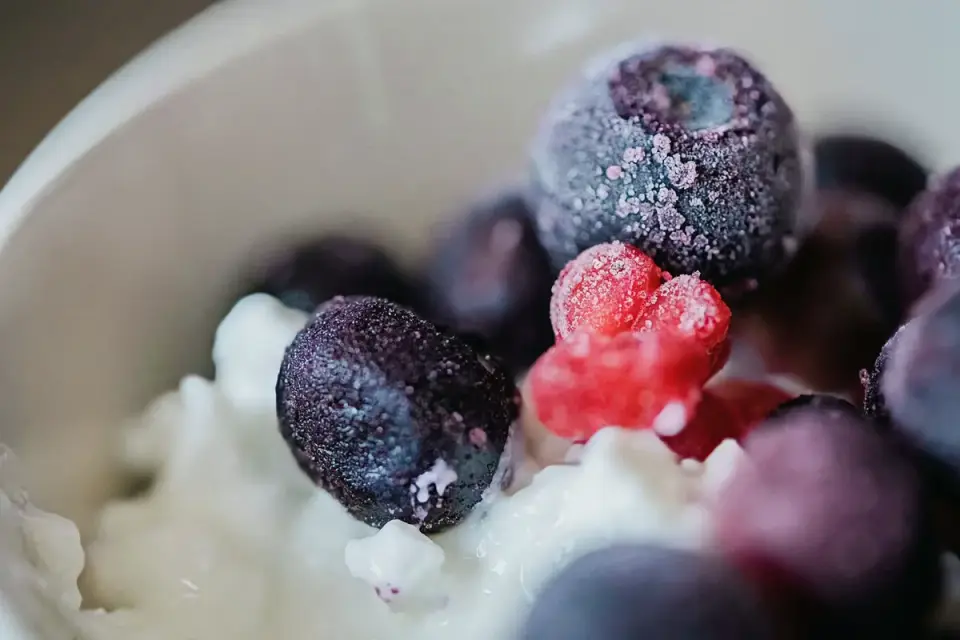
Start with something dense enough to plug the small opening — mashed sweet potato, plain canned pumpkin, or plain unsweetened yogurt all work and freeze into a seal a dog has to actually excavate. Layer in small chunks of cooked, unseasoned chicken or a spoonful of plain cottage cheese for texture variation, then top it off with a smear of the same base you started with so the whole thing freezes as one solid plug rather than a loose pile that falls out in two licks. If your dog is new to frozen enrichment or still teething, texture and hardness matter even more; I go through that timeline in Frozen Toys for Teething Puppies, because a filling appropriate for an adult dog’s jaw can be too hard on baby teeth.
The Ingredients I Rule Out Before I Ever Start Layering
Xylitol is the one I check for every time, without exception. It shows up in “healthier” sugar-free peanut butters marketed specifically for baking or dieting, and the ASPCA describes how it triggers a sudden insulin release in dogs, causing vomiting, lethargy, weakness, and in severe cases seizures. I read the label every single time, even on a jar I’ve bought before, because manufacturers reformulate without warning. Onions and garlic are the other reflexive no — not because they’re rare mistakes, but because they hide in baby food, broth, and pre-seasoned deli meat that owners assume is plain; I’ve written a longer breakdown of the dose and delay in Can Dogs Eat Onions? if you want the specifics. Beyond those two, I’m cautious with high-fat fillings in any dog with a pancreatitis history, and with dairy in dogs who’ve shown loose stool after cheese before. None of that needs to be complicated. It just needs to be checked before the Kong goes in the freezer, not after a 2 a.m. emergency call.
I had a client once who mixed shredded cheese, a spoonful of a “diet” peanut butter, and banana into her senior dog’s Kong — a kind combination on paper. The peanut butter carried xylitol. We caught it because she texted me a photo of the label out of habit, not because anything had gone wrong yet. That’s the whole argument for reading labels before freezing rather than after: by the time symptoms show, you’re not troubleshooting a recipe, you’re calling poison control.
My Actual Freeze Order, Step by Step
- Plug the small end with a spoonful of plain pumpkin, mashed sweet potato, or plain yogurt, pressed in so no air gap remains.
- Add a mid-layer of protein or texture — small chicken pieces, a little plain cottage cheese, or a few pieces of dog-safe kibble — pressed down, not just dropped in loose.
- Cap the wide opening with the same base you started with, smoothing it flush so nothing falls out as it thaws.
- Stand the Kong upright in a mug or egg carton before freezing, so the filling settles into the shape instead of sliding out one side.
- Freeze at least four hours, ideally overnight, before handing it over.
That standing step is small but it’s the one people skip, and it’s the difference between a Kong that lasts twenty minutes and one that’s a puddle on the floor in five.
The Peanut-Butter-and-Go Camp, and Why I Still Layer
I get the appeal of the one-ingredient approach — smear peanut butter in, freeze, done. It’s fast, dogs love it, and for a healthy adult dog with no sensitivities, a xylitol-free peanut butter isn’t dangerous in a reasonable serving. My argument against it isn’t safety; it’s mechanics. A single soft filling, even frozen, doesn’t demand nearly as much jaw work as a layered one with harder and softer textures stacked together, and it’s the sustained chewing and licking — not the specific food — that does the calming work described in that Frontiers review. If your goal is genuinely settling an anxious or under-stimulated dog rather than just filling a few idle minutes, texture variation is doing more of the job than flavor is. I’ll still reach for plain peanut butter as one layer among several. I just won’t build the whole Kong around it.
Where I Land With Owners
Otis is retired from frozen Kongs now — he’s older, his teeth are worn, and we’ve moved him to softer enrichment. But the layering habit stuck with his owner, and she still tells me it’s the only thing that reliably buys her forty-five quiet minutes on a night she needs to cook dinner in peace. That’s really the whole case for building a frozen Kong in layers instead of packing it with one convenient food: you’re not just feeding a dog, you’re prescribing a specific amount of chew time, and the ingredients underneath that decision matter far less than the structure holding them together. Rotate it with other food puzzles if your dog’s a fast finisher — I’d point you to Food-Dispensing Toys vs. Treat Balls for that comparison — but for a dog who genuinely needs to settle, a well-built frozen Kong is still the most reliable single tool I recommend.
Frequently asked questions
Is peanut butter safe to freeze in a Kong?
Plain, xylitol-free peanut butter is fine as one layer for most healthy adult dogs. Always read the label first, since some "diet" or "natural" peanut butters now contain xylitol, which the ASPCA links to insulin release and seizures in dogs.
How long should a frozen Kong filling be frozen before giving it to a dog?
At least four hours, and overnight is better. A softer freeze empties too fast to give the chewing benefit any real time to work.
Can I use the same frozen Kong filling for a puppy who's teething?
Not exactly the same one. Puppies need softer, more forgiving textures while their teeth are coming in, so check filling hardness against their specific stage before freezing an adult-strength Kong for them.
Sources
- Updated Safety Warning on Xylitol: How to Protect Your Pets — ASPCA
- Functional significance and welfare implications of chewing in dogs (Canis familiaris) — Frontiers in Veterinary Science