Why an Old Dog Shakes or Trembles More With Age
A hospice-trained vet explains the real reasons senior dogs tremble more — from cold and weak muscles to orthostatic tremor and White Shaker Syndrome — and what actually calls for a visit.
Eleven years in, most of the trembling I see in old dogs is not an emergency — but a few kinds are, and the difference is worth learning before you need it.
On this page
Before you read further, run this checklist. It sorts most of what I see in the exam room.
- Tremor happens mainly when standing, and eases when your dog lies down or walks → ask about orthostatic tremor.
- Whole-body, fine, fast trembling that started suddenly in the last few days, with no other signs → mention White Shaker Syndrome (generalized tremor syndrome) to your vet.
- Shaking only in cold rooms, thin-coated or low body-fat dogs, worse after a bath → likely simple thermoregulation, not disease.
- Trembling paired with confusion, pacing at night, or forgetting familiar routines → raise cognitive dysfunction, not just tremor.
- New trembling that started within days of a medication change (steroids, seizure drugs, thyroid dose) → call the prescribing vet before adjusting anything yourself.
- Trembling with weight loss, panting, or a racing heart → this is not a wait-and-see sign.
None of that list replaces an exam. It just tells you which question to lead with when you call.
The dog on the kitchen floor
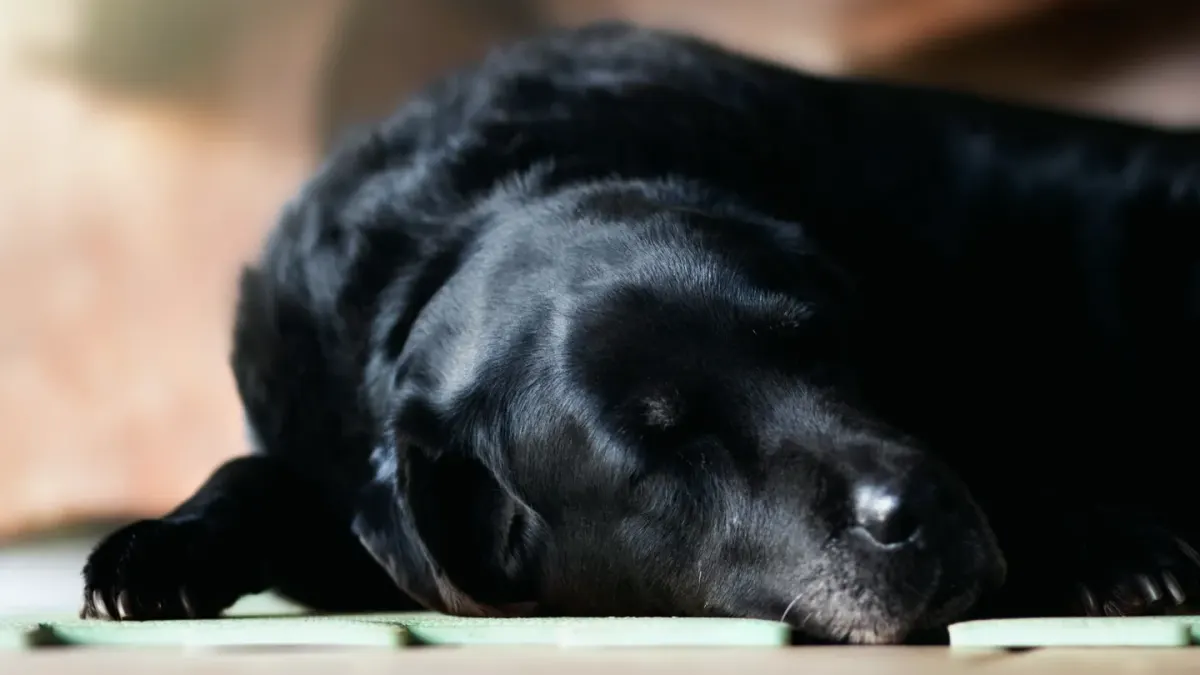
A 12-year-old Labrador I saw last winter would stand at his water bowl and his back legs would start to quiver — fine, fast, almost buzzing — and then stop the second he sat down or started walking again. His owner had assumed arthritis pain. It wasn’t pain, and it wasn’t cold; the room was warm and he weighed a stable 68 pounds. What she was describing, a tremor that appears specifically on standing and resolves with movement, is the classic pattern of orthostatic tremor. It is unusual, it is often missed for months, and it is treatable enough to be worth naming correctly the first time.
Weak trembling in an old dog is rarely one thing. It is usually two or three things layered on top of each other — thinner muscle, thinner fat, a nervous system that does not regulate temperature or posture as crisply as it used to — and the job in the exam room is to separate the layer that is normal aging from the layer that is not.
Why aging changes how a dog shakes
Muscle mass declines with age in dogs the same way it does in people, and less muscle means less reserve to hold a steady posture, especially on cold tile or a slick floor. Body fat often drops too in dogs who are eating less or losing lean mass, which removes some of the insulation that used to buffer a chill. None of that is disease. It is simply an older body working with a smaller margin.
Separately, the nervous system itself ages. Fine muscle control, the kind that keeps a limb steady while bearing weight, depends on nerve pathways that slow down over years. That slowing is one reason true orthostatic tremor — the pattern in the Labrador above — tends to surface later in life even though the underlying movement disorder itself is not exclusive to seniors. Veterinary neurologists studying dogs with this pattern found it associated with tremor specifically on standing that improves with active movement, most often affecting the pelvic limbs, sometimes appearing alongside other neurologic findings in Journal of Veterinary Internal Medicine. It is not the most common cause of senior trembling, but it is one of the more commonly missed ones, because it looks so much like ordinary weakness or arthritis pain.
The tremors that are not “just old age”
A few patterns deserve a same-week call rather than a wait-and-see approach.
Generalized tremor syndrome — sometimes still called White Shaker Syndrome even though it was first described in small white breeds and now shows up across coat colors — causes whole-body, fine, rapid trembling that comes on over a day or two, without an obvious trigger like cold or fear. Practical guidance from veterinary sources describing senior dog tremor lists it explicitly as a distinct entity involving inflammation in the central nervous system, separate from cold-related shivering or anxiety trembling, per Dr. Buzby’s ToeGrips for Dogs. It responds to treatment, but it needs to be diagnosed, not guessed at.
Medication side effects are the pattern owners miss most often, mostly because the timeline gets forgotten. Steroids, some seizure medications, and an overcorrected thyroid dose can all produce trembling that starts within days of a dose change. If a new tremor lines up with a new prescription or a dose adjustment, that connection matters more than anything else on this list — call the prescribing vet first.
I had a 9-year-old terrier mix, 22 pounds, whose owner tried warming pads and a thicker sweater for three weeks before mentioning that the trembling had started the same week her thyroid dose went up. It wasn’t the cold. It resolved within days of the dose being corrected. The lesson from that case is not “sweaters don’t work” — sometimes they genuinely help a thin, cold dog. It’s that a fix aimed at the wrong layer can look like progress while the real cause keeps running underneath it, which is exactly why the timeline question comes before the comfort question.
Where cognitive change fits in
Trembling that shows up alongside nighttime pacing, disorientation in familiar rooms, or a dog who seems to forget a routine mid-task is worth mentioning as a set, not as separate complaints. Anxiety and canine cognitive dysfunction both raise a dog’s baseline arousal, and a nervous system running hotter tends to tremble more easily even when nothing else is acutely wrong. This is not a tremor to fix in isolation. It is a comfort and quality-of-life picture, and the goal is steadying the whole dog — sleep, routine, a predictable environment — rather than chasing the shake itself.
What the ingredient research actually says
Two ingredients come up often in senior-dog conversations about cellular aging, and it is worth being precise about what is and is not shown. In laboratory work using a roundworm model, quercetin, along with unformulated forms and other antioxidants, did not affect the feeding behavior of the worms at the concentrations tested — a narrow finding about tolerability in that model, not a claim about tremor or cognition in dogs, per DOI.3390/ph19040525. Separately, embryonic exposure to a resveratrol-related compound accelerated development but shortened adult lifespan in an in-vitro model, a reminder that dose and life stage change how these compounds behave, per DOI.1016/j.phymed.2026.158531. Neither study was done in dogs, and neither says anything about trembling directly. If you see a supplement label leaning on either ingredient to promise steadier movement in an aging dog, ask what the guaranteed analysis actually names and at what dose — the panel on the back of the bag is the honest version of the story, the front is marketing.
For readers weighing whether an NAD+ precursor chew belongs in an older dog’s routine at all, our companion piece on what the evidence actually shows for energy changes around age eight covers that ground without overlapping with tremor specifically. And if trembling is showing up alongside a dog who startles more than she used to, it’s worth reading why some old dogs startle at sounds they used to sleep through — the two often share a nervous-system-aging root.
The bottom line
Most trembling in an old dog is the sum of thinner muscle, thinner fat, and a nervous system with less margin for error — not an emergency, and not something a warmer bed alone will always fix. Watch for the pattern that breaks that rule: tremor tied tightly to standing rather than movement, whole-body trembling that started suddenly, or any shake that lines up with a new prescription. Those get a call, not a guess. The rest deserve patience, a warm floor, and the kind of watching that notices when something genuinely changes instead of assuming it always has.
Frequently asked questions
Is it normal for an old dog to shake more even when she's not cold or scared?
Some increase in trembling is common with age because muscle mass and fat both decline, leaving less reserve for steady posture and temperature control. It's worth a vet visit if it's new, worsening, or tied to standing specifically rather than temperature or fear.
What's the difference between shivering from cold and a medical tremor?
Cold shivering usually resolves once a dog warms up and affects the whole body evenly. A medical tremor — like one tied specifically to standing, or one that comes on suddenly across the whole body — doesn't reliably go away with warmth and deserves a veterinary exam.
Should I stop my dog's medication if trembling started after a dose change?
No — call the prescribing vet before changing anything. A dose adjustment, not a full stop, is usually the safer first step, and stopping some medications abruptly can cause its own problems.
Sources
- Primary orthostatic tremor and orthostatic tremor-plus in dogs: 60 cases (2003-2020) — Journal of Veterinary Internal Medicine
- Is Your Dear Old Dog Shaking? 11 Reasons Why Senior Dogs Shiver — Dr. Buzby's ToeGrips for Dogs
- Quercetin, NAC, and ascorbic acid feeding behavior study — DOI:10.3390/ph19040525
- Embryonic resveratrol exposure and adult lifespan study — DOI:10.1016/j.phymed.2026.158531