Dog Treadmill vs. Outdoor Walking: What Actually Serves the Joints and the Brain
A treadmill can standardize a stride, but it can't replicate the varied load, terrain, and sensory work that keeps a dog's joints and brain genuinely fit.

On this page
A twelve-year-old Labrador named Otis came into my practice a few winters back because his owner, worried about ice on the sidewalks, had switched him almost entirely to a treadmill in the garage. He was still “getting his steps in,” she told me, twenty minutes a day at a steady 2.5 mph. But over about six weeks, she’d noticed he was slower to greet her at the door, his stool had gone looser, and he seemed less interested in sniffing the mail carrier’s scent trail through the yard — something he used to do every single morning without fail. Nothing was structurally wrong with him. What had changed was the input. A flat, repetitive belt gives a dog consistent footing and a controlled pace, but it strips out almost everything else a walk does: the change in camber, the cold air, the unpredictable stop-and-sniff rhythm that occupies a dog’s nose and brain as much as its legs.
That case sits at the center of how I think about this question, because owners tend to frame it as a binary — treadmill or walk — when the honest answer is that they solve different problems.
What a treadmill actually controls for
A treadmill’s real strength is uniformity. The surface is flat, the incline is adjustable, and the pace doesn’t wander the way a dog’s pace does when something interesting shows up thirty feet ahead. That makes it genuinely useful for a specific slice of dogs: those recovering from orthopedic surgery under a rehabilitation plan, dogs whose owners live somewhere walks aren’t safely possible for stretches of the year, or dogs being reconditioned after weight loss where a predictable, low-impact gait matters more than novelty. An underwater treadmill, used in formal rehab settings, adds buoyancy that further reduces joint loading — a different tool with a narrower, more clinical purpose than the dry-land home treadmill most owners are weighing here.
What a treadmill does not do is vary the load. A dog’s joints, tendons, and stabilizing muscles adapt to challenge — a slope, a soft patch of grass, a curb step — and that variability is part of what keeps connective tissue resilient rather than just repetitively worked. Flat, repetitive gait on a belt, done as the only form of movement, trades variability for consistency. For some recovering dogs that trade is exactly right. For a healthy adult dog, it’s a narrower diet of movement than the animal is built for.
Outdoor walking does more than move the legs
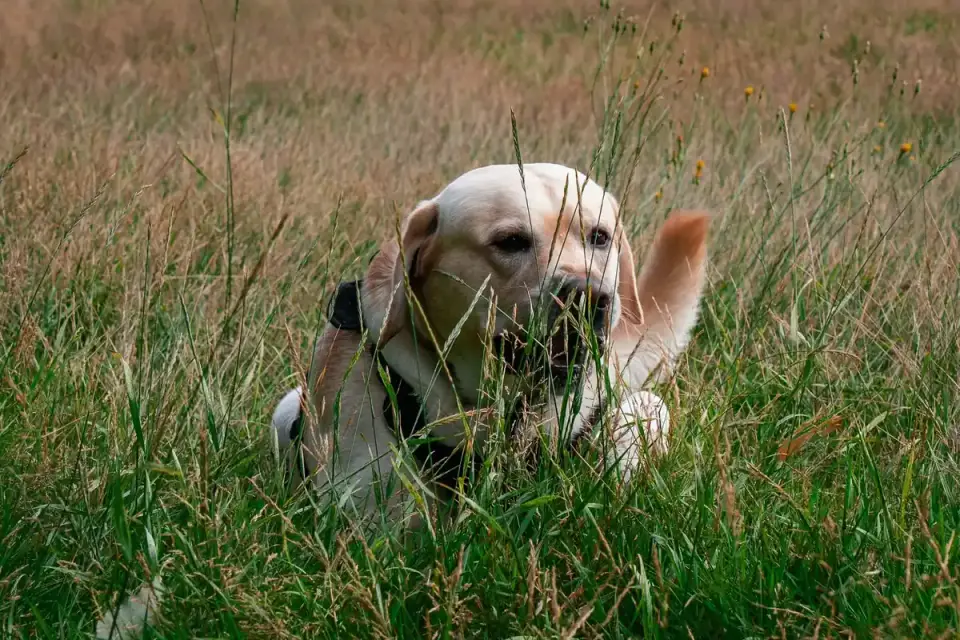
The sensory case for outdoor walking is not a soft one. A walk outside gives a dog constantly shifting terrain — asphalt, grass, gravel, mud — each of which asks something slightly different of the paw, the stifle, and the shoulder. It also delivers what canine behaviorists call “sniffari” input: the olfactory work of reading a scent trail, which taxes a dog’s brain in a way a treadmill belt simply cannot replicate. Owners who’ve swapped a bored, restless dog for a calmer one after adding sniff-focused walks aren’t imagining the effect; it’s a documented piece of canine enrichment.
Distance and duration matter here too, and they don’t have one right answer — they depend heavily on breed, age, and conditioning, which is exactly why I keep pointing clients toward our guides on how far a dog can walk or hike in a day and how long a dog’s walk should actually be rather than giving a single number in the exam room. A young, fit herding dog and a twelve-year-old Lab with early arthritis are not the same prescription, and neither is a toy breed, whose joint needs I’ve covered separately in terms of exercise built around small, delicate frames.
Where joint load and surface actually matter
This is where I want to be precise rather than reassuring. The evidence base for joint-support ingredients is not about walking surface at all — it’s about the cartilage and synovial environment underneath, and it’s worth separating from the terrain conversation rather than blurring the two.
Glucosamine has been shown, in laboratory conditions, to help prevent experimentally induced cartilage degradation in vitro, per a review in the Journal of Veterinary Medical Science — a mechanistic finding, not a claim about outcomes on a treadmill or a trail. Chondroitin, similarly, is described in a peer-reviewed study in Frontiers in Veterinary Science as supporting healthy synovial fluid homeostasis, which speaks to the internal environment of the joint rather than to any particular exercise surface. And green-lipped mussel powder, in research published in Nutrients, was shown to alleviate paw swelling in rats and reduce serum markers of inflammation including TNF-α and IL-17 — again, an inflammatory-pathway finding, not evidence about treadmills versus sidewalks specifically.
I’ll be direct about what that means: no study I can point to compares treadmill-walked dogs against outdoor-walked dogs on joint-support supplementation outcomes. What the literature supports is that certain ingredients may help support the joint’s internal environment regardless of where the dog is moving. The surface and duration questions are separate, behavioral and biomechanical ones — and they deserve their own answer, not a borrowed one from a supplement study.
I’ve had this conversation dozens of times with owners of aging, joint-compromised dogs who assume a treadmill is inherently “gentler.” Sometimes it is, particularly post-surgery under a rehab plan. But for a healthy senior simply managing early stiffness, a shorter, slower outdoor walk on forgiving terrain — grass rather than pavement, a dry afternoon rather than icy morning — often does more for both mobility and mood than a longer session on a flat belt. The owners who get this right tend to weigh cost of time, the dog’s actual tolerance that day, and what the dog seems to want, rather than defaulting to whichever option feels more controllable for the human.
The short version
Neither a treadmill nor an outdoor walk is categorically better; they answer different needs. A treadmill earns its place for controlled rehab, bad weather stretches, or dogs recovering from injury under professional guidance. An outdoor walk earns its place for nearly everything else — the sensory enrichment, the varied joint loading, the mental engagement a flat belt can’t offer. For most healthy dogs, the honest answer is both, in proportions that shift with the season, the dog’s age, and what a veterinarian or rehab specialist recommends for that specific animal. Where joint-support ingredients fit is a separate lane entirely: they may help support the joint environment a dog brings to either kind of exercise, but they don’t decide which kind of exercise is right.
Frequently asked questions
Is a treadmill bad for a dog's joints?
Not inherently — a flat, controlled surface can actually reduce joint loading compared to uneven terrain, which is why treadmills are used in formal rehabilitation settings. The concern is using one as a dog's *only* form of movement, since it removes the varied terrain and sensory engagement outdoor walking provides.
How long should a treadmill session be for a dog?
There's no single number that fits every dog; it depends on age, breed, and conditioning in the same way outdoor walk duration does. Start short, watch the dog's gait and enthusiasm rather than the clock, and build up gradually.
Do joint supplements help dogs that walk on a treadmill?
The evidence for ingredients like glucosamine, chondroitin, and green-lipped mussel powder concerns the joint's internal environment and inflammatory markers, not any particular exercise surface. They may help support that environment regardless of whether a dog walks on a belt or a sidewalk.
Sources
- Chondroitin sulfate supports synovial fluid homeostasis — Frontiers in Veterinary Science
- Glucosamine and cartilage degradation, an in vitro review — Journal of Veterinary Medical Science
- Green-lipped mussel powder and inflammatory markers — Nutrients