Swimming vs Walking for an Arthritic Dog: Which One Actually Helps?
Swimming spares the joint and walking rebuilds the muscle around it — an arthritic dog usually needs a planned mix, not a pick.
On this page
Is a dog with arthritis better off in the pool or on the sidewalk? Owners ask me this constantly, and the honest answer is that it’s the wrong first question. The right one is: what is this particular joint doing right now, and what does it need more of — relief, or strength?
Quick answer, if you need to move fast:
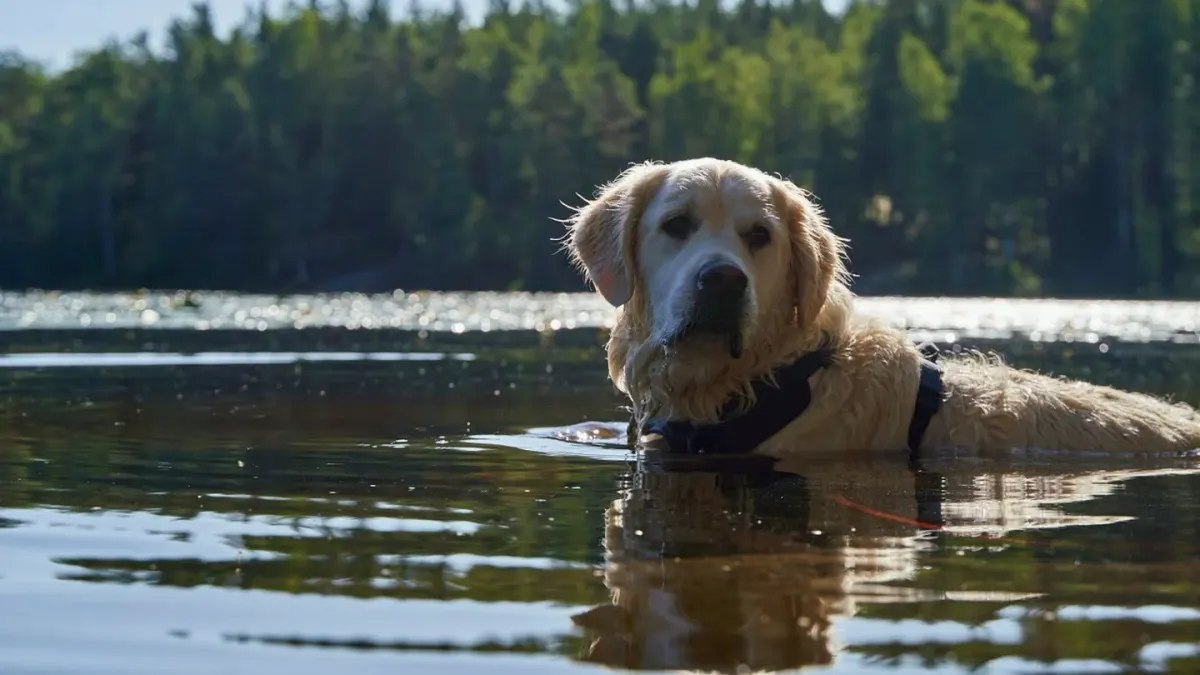
- Choppy, painful days, or a dog who’s flaring: favor swimming or controlled water walking. Buoyancy removes most of the load from the hip, elbow, or stifle.
- Stable days, or a dog building endurance: favor leash walking on a soft, even surface. It’s what actually strengthens the muscle that stabilizes the joint.
- Underweight muscle mass around a bad hip or knee: walking wins, because swimming alone doesn’t load the limb the way a weight-bearing gait does.
- Heat, hard pavement, or a dog who’s stiff after rest: swimming is gentler and easier to control.
- Most arthritic dogs, most weeks: you want both, sequenced — not a single winner.
- A dog who won’t get in water at all: don’t force it. A well-structured walking plan still works; it’s just not the whole toolkit.
I’ve watched this play out with a nine-year-old Labrador named Duke, sixty-eight pounds, who came in because his owner noticed he’d stopped jumping into the back of the SUV sometime that spring — she couldn’t pin down the exact week, only that it had “just happened.” He was stiff getting up from the kitchen floor in the morning, better by midday, worse again after a long walk on asphalt. We started him in a pool twice a week for controlled paddling, alongside short, flat walks on grass instead of his usual gravel trail. Within about six weeks his owner reported he was initiating stairs again on his own, though I’m careful to note that’s one dog’s trajectory, not a promise for every arthritic Lab.
Why the joint doesn’t care which one is “better”
An arthritic joint has two separate problems: pain from inflamed, degrading cartilage, and instability from the muscle that’s wasted away around it because the dog has been avoiding full use of the limb. Swimming addresses the first problem well. Buoyancy can offset a large share of a dog’s body weight, so a hip or stifle that hurts under full load gets to move through its range without bearing that load. That’s genuinely useful for a joint that’s inflamed or newly diagnosed.
Walking addresses the second problem. Weight-bearing exercise is what conditions the quadriceps, glutes, and core muscles that actually hold a joint in a stable position day to day. A dog that only swims can end up with decent cardiovascular fitness and a joint that’s still functionally unsupported on land, because swimming simply doesn’t ask the same muscles to do the same work in the same way.
Cartilage itself is part of why neither exercise alone is a cure. Frontiers in Veterinary Science: Chondroitin research has shown the compound supports healthy synovial fluid homeostasis, and synovial fluid is exactly what’s disrupted in an arthritic joint regardless of how the dog exercises. Exercise changes load and muscle support; it doesn’t rebuild degraded cartilage on its own.
What each exercise is actually doing at the tissue level
It helps to be specific about mechanism rather than treating “low-impact” as a vague virtue. In water, a dog’s limbs move through flexion and extension without the concussive load of a paw strike on concrete, which is why post-flare or post-surgical dogs tolerate it so well. On land, that same paw strike is what stimulates the proprioceptive feedback loop — the nerve signals that tell muscles when and how hard to fire to protect a joint. You lose some of that signal in water.
Journal of Veterinary Medical Science: Glucosamine HCl research indicates the compound can help prevent experimentally induced cartilage degradation in vitro, which is a laboratory finding, not proof that any single walk or swim session changes cartilage outcomes in a live dog. I bring it up because owners often want exercise to do the job nutrition and, in some cases, targeted joint support are meant to do. Exercise manages load and strength. It is not a substitute for addressing the biochemistry of the joint itself.
Green-lipped mussel is another ingredient worth knowing about here, mostly because it turns up so often in joint conversations. Nutrients published research where mussel-derived compounds alleviated paw swelling in rats and reduced markers of inflammation, including TNF-α and IL-17 — an animal model, useful context, but not a claim I’d extend directly to your dog’s morning walk.

Reading the dog’s actual day, not a general rule
I ask owners to track three things for a week before we decide on a ratio: how the dog moves first thing in the morning, whether they’re reluctant on stairs or jumping onto furniture, and how they look after twenty minutes of activity — not during it, after, once the adrenaline’s worn off. A dog who’s fine during a walk but audibly stiff an hour later is telling you the joint is being asked to do more than it currently tolerates.
For a lot of dogs the practical split looks like two or three short land walks most days — see our guide on how long a dog’s walk should be for age- and joint-specific pacing — plus one or two pool or water-treadmill sessions weekly when there’s access to either. Distance matters too; if you’re building up a dog’s daily mileage around a joint issue, our piece on how far a dog can walk or hike in a day covers how age changes that ceiling. Small-breed arthritis, incidentally, plays out differently than it does in a Labrador — our exercise guide for toy and small breeds is worth a look if you’re working with a smaller dog.
There’s also a category of dog that swimming just doesn’t suit — some genuinely dislike water, and forcing the issue adds stress that outweighs the joint benefit. For that dog, a well-built walking program, kept short, frequent, and on forgiving ground, still does real work. It’s not a downgrade; it’s a different toolkit for the same goal.
The verdict, and why I land there
Near the end of most of these conversations, an owner asks me to just pick one. I don’t, and here’s the honest reasoning: a dog mid-flare, sore and guarding the limb, gets more benefit from water this week than from another walk. A dog who’s stable but visibly weak through the hindquarters needs the strengthening that only weight-bearing movement provides. Treating this as a single either/or question ignores that arthritis itself isn’t static — it has better weeks and worse ones, and the right exercise changes with them.
The strongest counterargument I hear is that swimming is simply safer across the board, so why not default to it. I don’t buy that as a universal rule, because a joint surrounded by wasted muscle is a joint at higher risk of further injury, flare, or compensatory strain elsewhere in the body — a weak hip changes how the opposite stifle gets loaded, for instance. Muscle is protective, and only weight-bearing exercise reliably builds it back.
What I tell owners, and what I’d want for my own dog, is to weigh what any single intervention can realistically do for diet, mobility, and recovery rather than expecting one modality to cover the whole job. Swimming and walking are tools for different problems inside the same joint. Neither replaces good joint nutrition, veterinary monitoring, or a plan that shifts with how the dog is actually doing that week — not the one you drew up three months ago.

Quick answers
Q: Can I just switch a stiff dog straight to swimming and skip walks entirely? A: Not usually. Swimming reduces pain during exercise, but skipping weight-bearing movement long-term can leave the stabilizing muscles around the joint undertrained.
Q: How often should an arthritic dog swim? A: There’s no single number that fits every dog; it depends on joint severity, access to a safe pool, and how the dog tolerates it. Work with your veterinarian to set frequency based on how the dog responds.
Q: Is a water treadmill different from open swimming? A: Yes — a water treadmill lets you control depth and pace precisely, which some dogs tolerate better than open swimming, especially early in rehab.
Frequently asked questions
Can I just switch a stiff dog straight to swimming and skip walks entirely?
Not usually. Swimming reduces pain during exercise, but skipping weight-bearing movement long-term can leave the stabilizing muscles around the joint undertrained.
How often should an arthritic dog swim?
There's no single number that fits every dog; it depends on joint severity, access to a safe pool, and how the dog tolerates it. Work with your veterinarian to set frequency based on how the dog responds.
Is a water treadmill different from open swimming?
Yes — a water treadmill lets you control depth and pace precisely, which some dogs tolerate better than open swimming, especially early in rehab.
Sources
- Chondroitin and Synovial Fluid Homeostasis — Frontiers in Veterinary Science
- Glucosamine HCl and Cartilage Degradation — Journal of Veterinary Medical Science
- Green-Lipped Mussel Compounds in Inflammatory Models — Nutrients